 Arctic Council Working Group
North Atlantic Thick-Billed Murre International Harvest Management Strategy
Better understanding and addressing declines in Thick-billed Murre (ᐊᒃᐸ Appa, Polarlomvi, Stuttnefja, Brünnich’s guillemot, Uria lomvia) populations.
 The North Atlantic Thick-Billed Murre International Harvest Management Strategy is a project under the Conservation of Arctic Flora and Fauna (CAFF’s) Circumpolar Seabird Expert Group (CBird) workplan to better understand and address declines in several Thick-billed Murre (ᐊᒃᐸ Appa, Polarlomvi, Stuttnefja, Brünnich’s guillemot, Uria lomvia) populations.
The project was started in 2025 by representatives from the range states (Canada, Greenland, Iceland and Norway). It aims to develop a coordinated international harvest management strategy for thick-billed murres across the North Atlantic, with stakeholder and rightsholder collaboration. The goal is to sustain the breeding range and population size of thick‐billed murres within each breeding and wintering area and to maintain sustainable hunting where it is permitted. The project team includes international species and harvest management experts, science and harvest management representatives from the range states and a representative of the Inuit Circumpolar Council. The project team will produce a strategy providing advice to the national governments involved. Those governments have national and regional processes to set rules for harvest.
Populations of thick-billed murres breeding throughout the North Atlantic are highly migratory during the non-breeding season and are harvested in the waters of several range states. Research suggests that a shortage of food in winter may be one of the main reasons for the declines. Birds from declining populations that winter primarily southwest of Greenland are working harder than those wintering along the coast of Newfoundland and Labrador). The winter food shortage is likely driven by the rapidly changing Arctic climate. While harvest of the murres is not thought to be the biggest cause of population declines, it is one area where changes might help slow or stop the species decline.
The project team wants to understand the perspectives of people who have an interest in the birds and is working to engage stakeholders and rightsholders in the regions where the birds live.
Thick-Billed Murres in the Northwest Atlantic
Thick billed murres (Brünnich’s guillemot, Appa, Polarlomvi, Stuttnefja, ᐊᒃᐸ, Uria lomvia) can live for as much as 40 years. At most, they produce one chick per year.
Chicks leave their nesting ledge on the cliff when less than half grown and jump into the ocean. There they meet with their fathers who feed and care for them. The fathers cannot fly at this stage because they are moulting. The fathers and chicks swim long distances, sometimes more than 1000 kilometres to reaching wintering grounds that do not ice over.
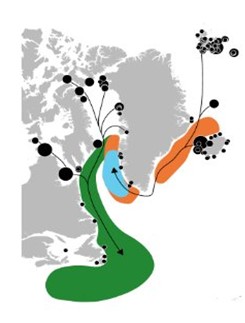
This map shows breeding colonies, migration routes and main wintering areas in the northwest Atlantic. Black dots show the colonies, and the lines and arrows show the routes they take in the fall. The green shows the wintering area mostly used by birds from colonies in Canada and northwest Greenland. The two orange areas are mostly used by birds from Svalbard and Iceland, and the blue area is mostly used by birds from southwest Greenland. Because of the mixing of birds from different breeding colonies in their winter range, both environmental conditions and human activities in winter affect breeding colonies in several countries.
Thick-billed murre breeding colonies in Svalbard, Iceland and most of Greenland have declined in size over the past ten years, whereas colonies in northwest Greenland are increasing. In Canada, the status of the murre colonies is not well known, but the Canadian government is working on establishing the current status of the Canadian population.
International management of Thick-billed murre is needed due to the species highly migratory nature, which results in birds from different breeding regions and countries, with differing population trends, mixing on the wintering grounds.
The most important cause of decline is likely a lack of food in winter. Researchers have tracked birds with electronic tags. Murres wintering in areas around Greenland have to work harder for food in winter than those wintering along the Canadian coast. The assumption is that this change in food availability may be linked to climate change.
Harvest also inevitably reduces populations, but cannot on its own explain the observed declines.
Other potential causes include:
- Extreme weather – murres may be stressed by e.g. increasingly hot Arctic summers
- Disturbance – increased human activity near colonies, including harvest and tourism may also add to stress, accidents to chicks, and other impacts
- Bycatch – this was once significant, but major reductions in gillnet fishing along with some improvements in fishing methods mean this is likely not as important a driver recently
- Contaminants – not thought to be an important driver.
Harvest levels seem to have declined over the past few years. Estimates for current annual harvest levels are:
- Canada (primarily Newfoundland and Labrador) – 40,000 - 95,000
- Greenland – 25,000
- Iceland – less than 5,000
Changing harvest regulations could be one response to the declining populations. Because breeding populations mix in winter, harvest levels should ideally be managed according to an internationally agreed management plan.
National project representatives:
-

Morten Ekker
AMBI Steering Group, AMBI African-Eurasian Flyway Committee, AMBI Circumpolar Flyway Committee representativeNorway






Project team:
-
Morten Ekker
AMBI Steering Group, AMBI African-Eurasian Flyway Committee, AMBI Circumpolar Flyway Committee representativeNorway






Expert advisors:
-

Fred Allen Johnson
North Atlantic Murre Harvest Management Project RepresentativeKingdom of Denmark -

Morten Frederiksen
North Atlantic Murre Harvest Management Project RepresentativeKingdom of Denmark